
The Evidence Trail for Arcadia Previous Residents
One Arcadia address can have an ownership trail, an occupant trail, and a building trail. The ownership trail runs through recorded instruments. The occupant trail runs through printed directories, census schedules, newspapers, and obituaries. The building trail runs through assessment facts, permits, planning packets, and historic surveys. These sources overlap, but none is a complete list of Arcadia past households.
| Source | Years It Covers | Where Held | What It Shows |
|---|---|---|---|
| Arcadia recorded deed indexes | 1850/1851-present | RR/CC Norwalk | Owners, transfers, liens, legal descriptions |
| Arcadia city directories | 1923-present | History Room | Listed residents, addresses, occupations, reverse entries |
| Arcadia papers | Microfilm from 1931 | History Room and digital library | Moves, notices, obituaries, property news |
| Arcadia federal census schedules | Through 1950 in 2026 | NARA, library, FamilySearch | Household members, ages, relationships, tenure |
| Arcadia building permits | Surviving city files | Arcadia departments and requests | Work dates, applicants, owners, contractors |
| Arcadia assessment parcel | Current and displayed roll facts | LA County Assessor | AIN, situs, physical facts, values, legal description |
| Sanborn maps | Arcadia years unconfirmed | LOC or library search | Footprint and use only if coverage exists |
The table is an Arcadia research plan, not a promise that every source has a complete Arcadia run. The History Room must verify directory gaps and reverse sections, and no official Arcadia Sanborn year list was found.
Begin Arcadia Previous-Resident History With Today’s AIN
Resolve the current Arcadia street address in the Los Angeles County Assessor Portal. Record the AIN, situs, legal description, year built or effective year, map index, tax-rate area, and building or land facts. The public result does not expose a complete owner or mailing field, so do not treat the Arcadia parcel page as proof of the current household.
The Arcadia legal description is the continuity key. A street number can be reoriented or associated with a different lot after a subdivision. An AIN and land description help test whether a deed, permit, directory, and historic survey refer to the same ground. Use the county map and Arcadia zoning viewer to see adjacent parcels and linked permit history.
The Los Angeles County Recorder service is the next Arcadia source after the parcel facts, but it needs a name and year rather than the address.
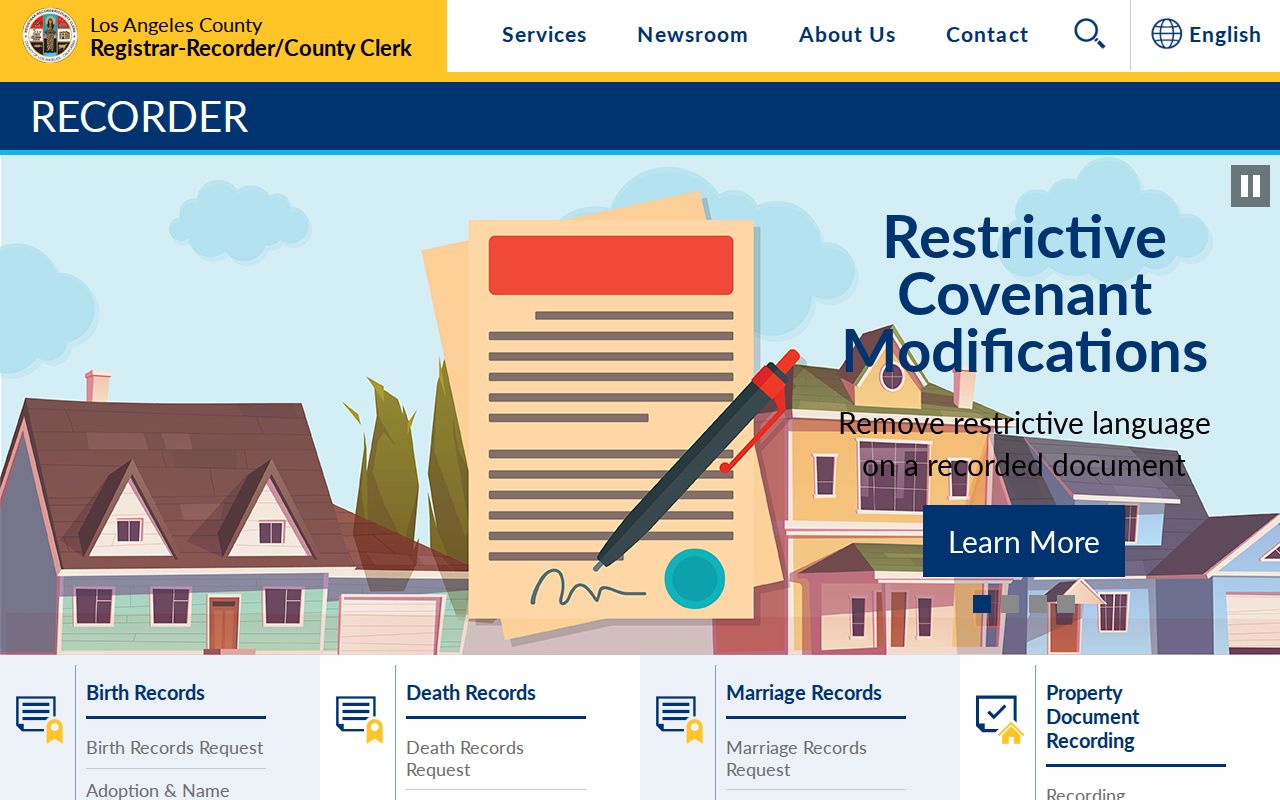
The recorder-service view represents the county half of an Arcadia previous residents search after the parcel has supplied a usable land key.
Arcadia Previous Residents Through the Deed Chain
Arcadia’s Los Angeles County records reach to 1850 or 1851, but the real-estate index is not online and cannot be searched by street address or AIN. It is alphabetical by name and recording year. Make a Norwalk appointment, identify the current owner or deed clue through lawful channels, and search the person as a grantee in a likely acquisition year.
- Write down the current AIN, legal description, and every known owner or document clue.
- Search the likely grantee name in the correct annual alphabetical index and retrieve the purchase deed or instrument number.
- Read the grantor, grantee, recording date, document number, document type, and legal description on the result.
- Search the earlier grantor as a grantee in prior years, testing spouse, trust, entity, and spelling variants.
- Stop when the legal description changes or the parcel splits, then use maps and recorded documents to reconcile the land.
An Arcadia grantor is the party transferring an interest. A grantee receives it. The chain of title is the sequence of instruments showing how an interest passed. The legal description is the land wording that keeps a chain from relying on a street number alone.
The RR/CC in-person request instructions provide the appointment and copy-access route.
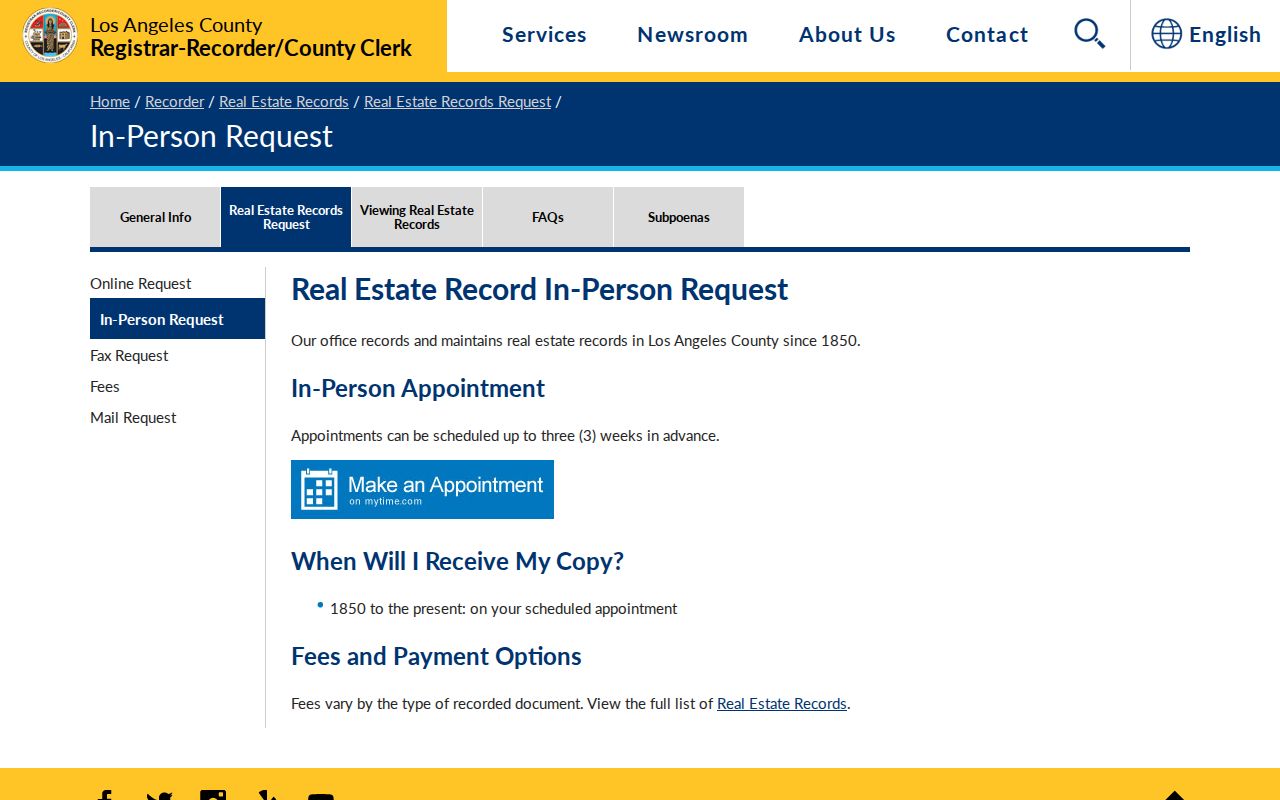
In-person access is essential because an Arcadia previous residents deed trail cannot begin with an online address search.
Arcadia Previous-Resident Recorder Research
Arcadia recorder research has a physical cutoff. Indexes for 1851-1957 are reviewed on the lower level. Indexes for 1958-present are on the second floor, Room 2207. Appointment windows are released several weeks ahead. A mid-century chain can require time on both floors, so write the target year range before arriving.
Arcadia copies are separate from viewing. The research record lists $6 for the first page and $3 for each additional page, with other search, certification, payment, and vendor rules depending on the request. Online copy ordering requires enough information, such as a document number or names plus recording year and document title, and may take about 20 business days. Verify current fees and processing before ordering.
The RR/CC recording-fee schedule is the source to check before requesting a copy.
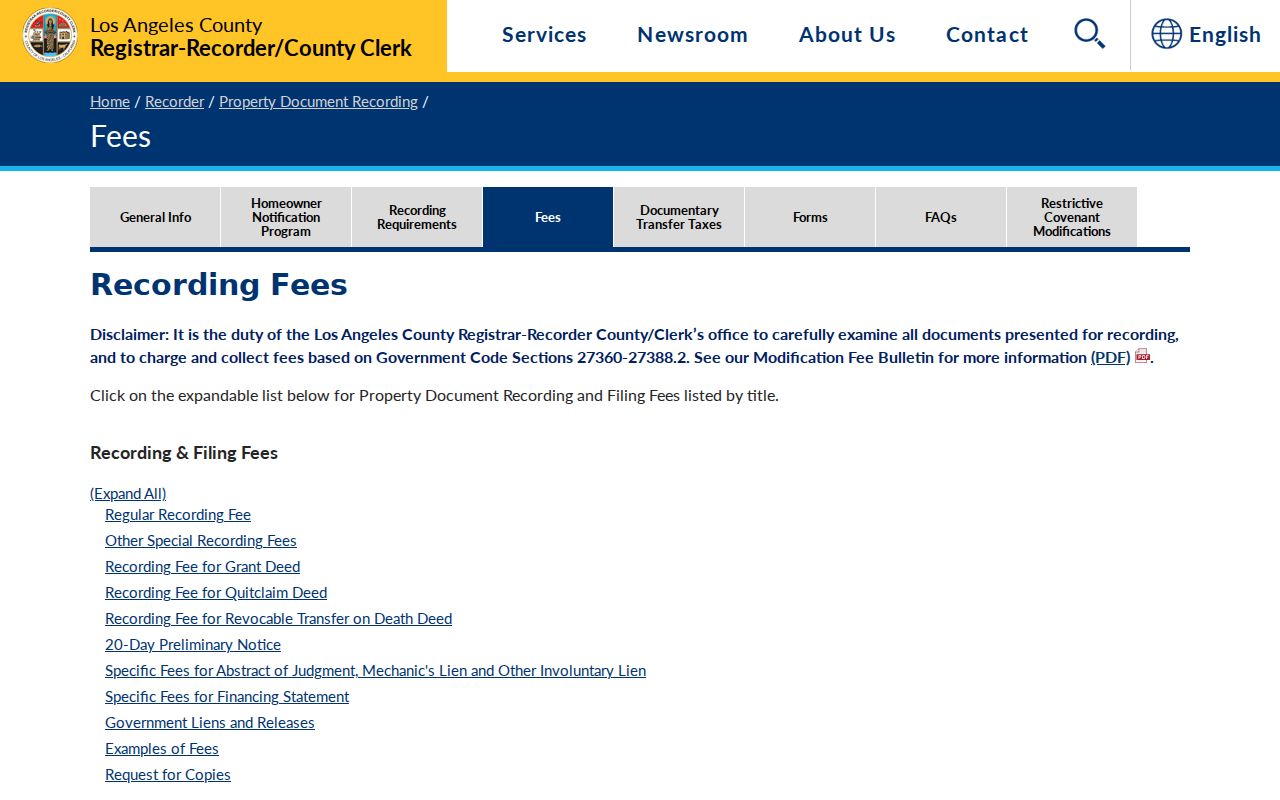
Arcadia fee guidance is a reminder to distinguish free index viewing from paid copies or certification.
The Los Angeles County County Clerk services provide the related marriage, fictitious-business-name, and notary filing routes when an Arcadia previous resident trail reaches a county filing.
County Clerk material for Arcadia can add a dated public filing, but it remains a different record set from a deed or directory entry.
Note: The 1957-1958 boundary is Arcadia research metadata, not a break in Arcadia ownership history or Arcadia parcel continuity.
Use Arcadia Directories to Find Past Occupants
Owners are not the same as previous residents. The Arcadia History Room holds Arcadia city directories from 1923-present, with gaps and reverse-section availability to verify by edition. Search an Arcadia surname entry, then turn to the street-order section when present. Capture house number, street, spouse, occupation, phone, and the edition’s abbreviation key. A disappearance can mean a move, death, omission, or missing volume.
The Arcadia city directory collection reference explains how to read those entries. For this backward trail, the important habit is to keep one Arcadia address and one publication year per line. Pair a listed occupant with the parcel’s AIN and the census date, not with an assumption that the person owned the land.
Pair Arcadia Directory Years With Census
The Arcadia federal census supplies ten-year snapshots through 1950 in 2026. It can show household members, ages, relationships, occupation, and tenure at the enumeration date. The Arcadia city directory fills some of the years between census schedules. The two sources use different dates and definitions, so a household can look different even when the address is the same.
- Copy the directory entry and its publication year without expanding abbreviations from memory.
- Find the closest 1930, 1940, or 1950 census schedule and record the enumeration date.
- Compare names, ages, relationships, street number, and tenure while allowing for moves within the decade.
- Use the next directory year to bracket an arrival or departure.
An Arcadia census household can include people absent from a printed directory. A directory can list a householder after a census date has passed. The difference is useful when it is labeled, not when it is silently merged.
Arcadia Previous Residents and Permit History
Arcadia Building Services retains past permit information according to its public instructions, but Arcadia single-family floor plans are not kept. Commercial and multifamily plans may survive. A permit or planning packet can identify an owner, contractor, applicant, construction date, project type, architect, or alteration. Historic-preservation packets may combine permits, directories, voter registrations, census material, and aerials for one address.
Search the Arcadia city repository by the exact address plus “historic,” “DPR 523,” or “Planning Commission” when those terms fit the project. Harvest citations and verify the underlying record. A planning packet for 1014 Hampton Road, for example, traces a 1937 permit to owner Alva C. Surber and contractor C. C. Boening. That is a model of evidence for one researched address, not a claim about every Arcadia parcel.
Arcadia permits date the physical story. They do not establish every person who lived there.
Close an Arcadia Resident Trail With Obituaries
The Arcadia History Room’s online history collection includes obituary citations, photographs, documents, and clippings. Arcadia newspaper microfilm begins in 1931, and the library identifies Arcadia Weekly from 2005-current and Pasadena Star-News from 2001-current in its digital offerings. Search an occupant’s full name, spouse, street, institution, and likely move year.
Arcadia probate can supply heirs, devisees, a personal representative, counsel, petitions, notices, and orders. Recorded distribution deeds can connect the estate to the parcel. Death indexes may point toward an event, but a certified copy has separate eligibility rules. Together, obituary and probate evidence can explain why a directory entry ends without claiming that disappearance alone proves death.
For a former Arcadia resident who worked at Santa Anita Park, the U.S. Army Balloon School, or the 1942 assembly center, institutional newspapers and photographs may be more useful than a conventional address listing.
Bridge Arcadia Previous Residents Across Address Changes
Arcadia house numbers are generally stable today, but Arcadia allows changes for new construction, new multifamily units, or a corner-home remodel that changes the facing street. That modern rule does not prove that every old number survived. Search directional prefixes, spelling variants, subdivision names, Rancho Santa Anita, Baldwin Ranch, Santa Anita, and Los Angeles County when a pre-1923 record does not say Arcadia.
Use the AIN, tract, lot, block, map index, and legal description to bridge a historical Arcadia number to current land. If the legal description changes, pause and reconcile the transfer or subdivision before continuing the previous residents chain. An Arcadia street directory and a ZIP label are weaker continuity keys than the parcel record.
Keep Arcadia Previous Residents in Their Time
Arcadia previous residents are historical people connected to a dated place, not a current household list. Printed entries can lag moves. Deeds can omit occupants. Census schedules are snapshots. Permit names reflect a project. Obituaries and probate describe an endpoint. A sound Arcadia house history keeps every source’s date and role visible.
Lawful personal use. Use Arcadia past-resident records for family history, estate research, and responsible property history. Do not use a name or address trail to stalk, harass, intimidate, or harm anyone.
The most durable sequence is current AIN, legal description, deed chain, directory years, census pairing, permits, and obituary or probate evidence. An Arcadia previous residents timeline should keep each of those layers dated. When an Arcadia source is missing, mark the gap and ask the custodian rather than filling it with a guess.