
Arcadia’s City Directory Shelf
The Arcadia Public Library History Room is the keeper to ask first. Its official inventory describes Arcadia city directories from 1923-present, school yearbooks, newspapers on microfilm from 1931, census microfilm, maps, scrapbooks, photographs, clippings, and local-government or business history. One locally cited volume is Polk’s Arcadia City Directory, 1960. The Arcadia web inventory confirms the span but does not list every publisher, gap, or reverse section, so a researcher should ask staff before promising an exact year.
| Collection | Years | Where Held | Access |
|---|---|---|---|
| Arcadia city directories | 1923-present | History Room | Appointment; ask about gaps |
| Arcadia reverse or criss-cross sections | Edition dependent | Directory volumes | Ask staff for street-order pages |
| Arcadia newspapers | Microfilm from 1931 | History Room | Appointment and reader access |
| Arcadia school yearbooks | Not itemized online | History Room | Appointment; student or faculty names |
| Digital history and obituary index | Collection-specific | Arcadia History database | Free search and metadata |
The Arcadia city directory shelf is a series, not one database. Missing years, publisher changes, and edition-specific abbreviation keys must be recorded as research notes rather than filled with assumptions.
Note: “1923-present” describes the official Arcadia collection span, not proof that every annual volume survives on the shelf.
Arcadia Directory Appointment at History Room
The History Room is at Arcadia Public Library, 20 W. Duarte Road. Physical access is by appointment through 626-821-5569 or ref247@arcadiaca.gov. The general library contact is 626-821-5567, and published general hours are Monday through Thursday 10-9 and Friday through Saturday 10-6. Ask for the directory series, the volume year, the reverse section, the abbreviation page, and any restrictions on copying.
The Arcadia room’s scale matters. It holds roughly 2,000 photographs, three file cabinets of newspaper clippings, Arcadia newspapers on microfilm, census microfilm, yearbooks, and material chiefly covering the 1870s-present. A librarian can identify an Arcadia shelf gap or a place name that an online surname search misses. Bring a known address, a time range, variant spellings, and the names of spouses or adult household members.
The official Arcadia History Room description is the source for current appointment details and holdings.
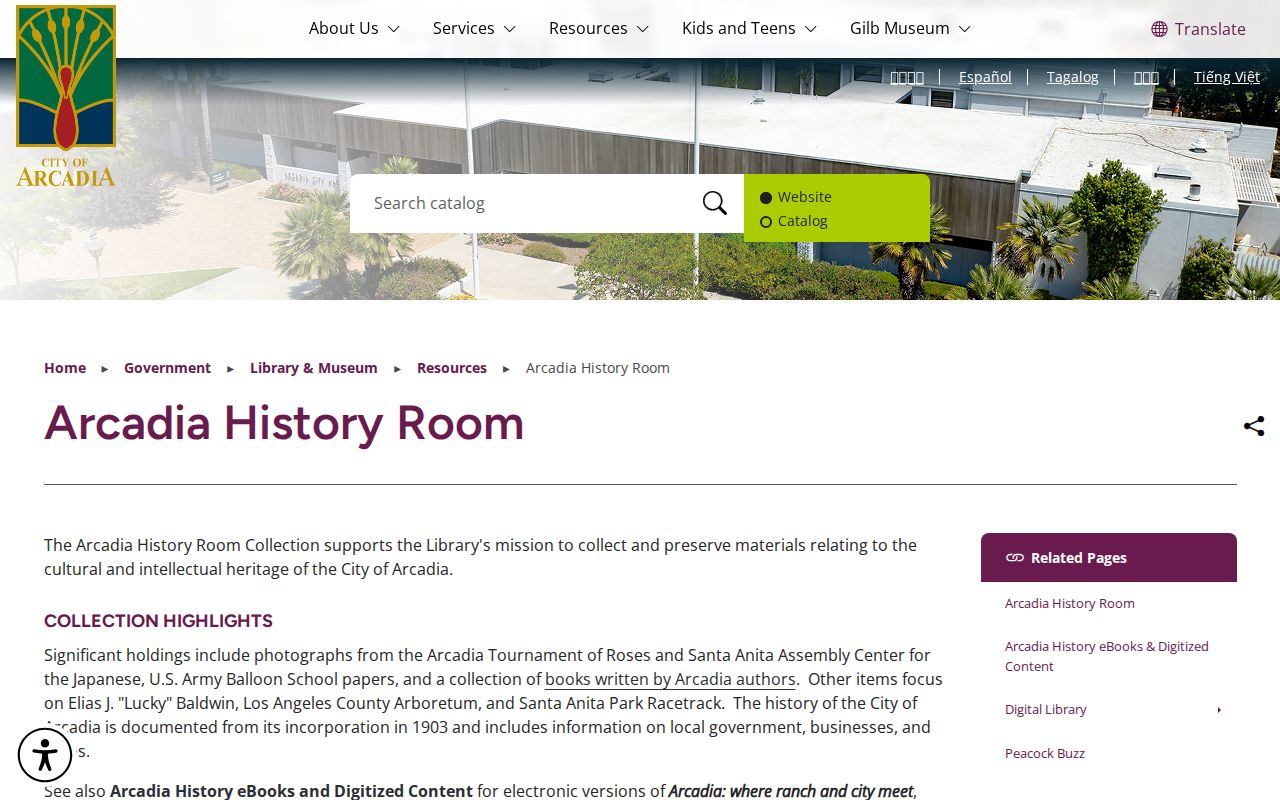
The Arcadia History Room view represents the physical shelf that completes the online Arcadia city directory search.
Reading an Arcadia City Directory Entry
A Polk-style Arcadia city directory entry is usually alphabetized by surname. It may give a surname, given name or initial, spouse in parentheses, occupation, residence marker, street address, telephone, and a notation such as widow. Exact Arcadia abbreviations vary by edition. The front matter matters as much as the name page because it explains marks used by that publisher.
| Resident name | Primary listed person, initials, and a spouse cross-reference where printed. |
|---|---|
| Occupation | A distinction clue for two people with the same name. |
| Street address | House number and street, sometimes with a telephone or residence mark. |
| Household notation | Spouse, widow, removal, or new-resident marks in some editions. |
| Reverse entry | Street-order data when the volume includes a guide or criss-cross section. |
- Criss-cross directory
- The street-order portion of a volume. It starts with a house number and street rather than a surname.
- Householder index
- A finding list centered on the person treated as the household’s principal listed resident.
- Abbreviation key
- The publisher’s legend for short forms and marks. Photograph or transcribe it before interpreting an entry.
Flip Arcadia Directories Into Street Order
The Arcadia surname section answers “who was listed?” The reverse section answers “who was listed at this number?” When an Arcadia edition includes a street guide, transcribe the house number, street spelling, listed name, telephone, and any abbreviation exactly. Keep the publication year beside the entry. A reverse directory can reveal nearby listed households and a street’s older numbering, but it does not prove ownership or include every occupant.
Use a street-order entry as a bridge to an Arcadia parcel. Compare the address against the Assessor Portal and legal description, then check whether the number belongs to the same land after a subdivision or corner reorientation. Do not treat an owner listed in a deed as the same person as a householder in a directory without a second anchor.
Note: Reverse sections vary by edition, so an absent street listing may reflect the volume rather than an empty Arcadia address.
Tracing Arcadia Households Through Directory Years
An Arcadia city directory becomes a family-history timeline when each entry is copied in sequence. Start with a known address or person, then bracket the first and last appearance. Follow surname variants, initials, spouses, and adjacent addresses. A person’s disappearance can mean a move, death, omission, or a missing volume. Use newspapers, obituaries, probate, and later directory entries to tell those possibilities apart.
- Find the earliest Arcadia directory year that could contain the person and photograph the title or citation details.
- Read the surname and reverse sections for consecutive volumes, recording address, spouse, occupation, and every abbreviation.
- Compare the address with the parcel’s AIN and legal description so a number change is not mistaken for a move.
- Pair the 1930, 1940, and 1950 directory evidence with the corresponding public federal census, allowing for enumeration dates.
- When the name disappears, check the History Room obituary index, newspaper microfilm, probate case, and recorded transfer trail.
Arcadia census schedules provide household members, ages, relationships, occupation, and tenure at a fixed date. Arcadia directory volumes fill the years between those ten-year snapshots. Together they can show an arrival, a spouse’s name, a move down the street, or a household that was present for only a short period.
Arcadia’s Directory Timeline Has Two Eras
Arcadia’s record trail predates the city directory shelf. Los Angeles County was organized in 1850, Arcadia incorporated in 1903, the library began as an LA County branch in 1913, and it became a city library in 1920. The local directory run begins in 1923. That sequence explains why a pre-1923 person may be described by Rancho Santa Anita, Baldwin Ranch, Santa Anita, or Los Angeles County rather than Arcadia.
| 1850-1851 | County land-record coverage begins in the RR/CC historical range. |
|---|---|
| 1903 | Arcadia incorporates; older Arcadia people and parcels may use ranch or county place names. |
| 1923 | Official local city-directory series begins. |
| 1931 | Arcadia newspaper microfilm begins in the History Room inventory. |
| 1942 | Santa Anita Pacemaker documents the Arcadia assembly-center community. |
| 1950 | Latest public federal census schedule in 2026 under the 72-year rule. |
Arcadia Newspapers Extend the Directory Trail
The History Room’s newspaper shelf can explain a change that a city directory only hints at. Microfilm begins in 1931. Library digital offerings include Arcadia Weekly from 2005-current and Pasadena Star-News from 2001-current under their stated access terms. Search notices, weddings, obituaries, school achievements, business openings, property hearings, and community events with a name plus an address or institution.
Two unusual Arcadia publications broaden the resident story. The 1918-1919 Arcadian Observer records the U.S. Army Balloon School community. The 1942 Santa Anita Pacemaker and Arcadia assembly-center photographs document Japanese Americans confined at Santa Anita. These are important because transient or confined people can be absent from a conventional homeowner narrative while appearing in institutional newspapers and photographs.
The Arcadia Historical Society supplies context, markers, and programs. It is a historical source, not a resident roster.
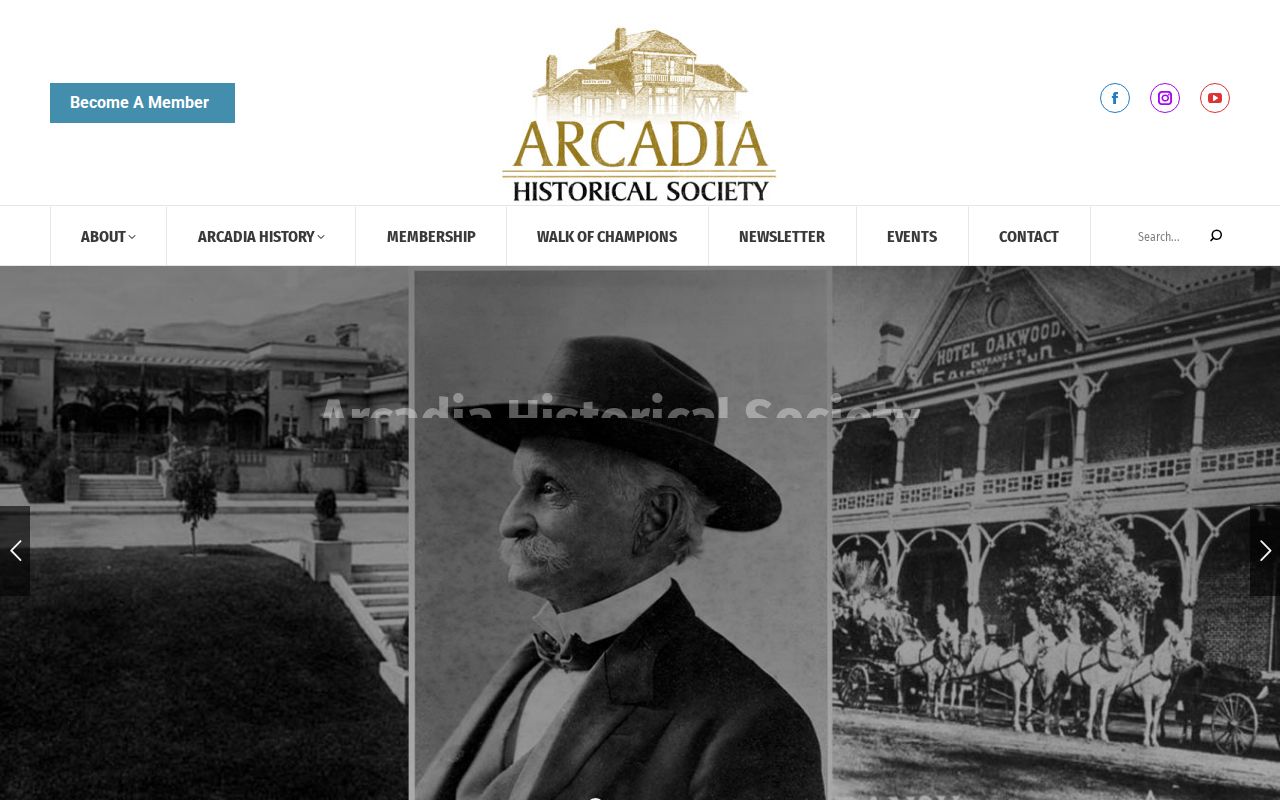
Arcadia Historical Society context can supply place names and dates that make a directory search more precise.
Digitized Arcadia History Beyond Printed Volumes
The searchable Arcadia History collection provides Arcadia photographs, documents, citations, clippings, obituaries, and paintings. The library’s digital guide also points toward genealogy resources, digital newspapers, Archives Unbound, Pasadena Star-News material, and California Revealed projects. Metadata may be available online while the original photograph, clipping, or directory remains a room appointment item.
Arcadia’s local-history books include Arcadia: Where Ranch and City Meet and Visions of Arcadia. The California Revealed work includes historic city directories and an Anoakia Breeding Farm private catalog. Search “Santa Anita,” “Rancho Santa Anita,” “Baldwin Ranch,” and “Arcadia” when a surname search fails. Record the citation and verify the underlying item before treating a database note as a fact about a person.
The Arcadia Public Library digital-library guide is the access point for these related collections.
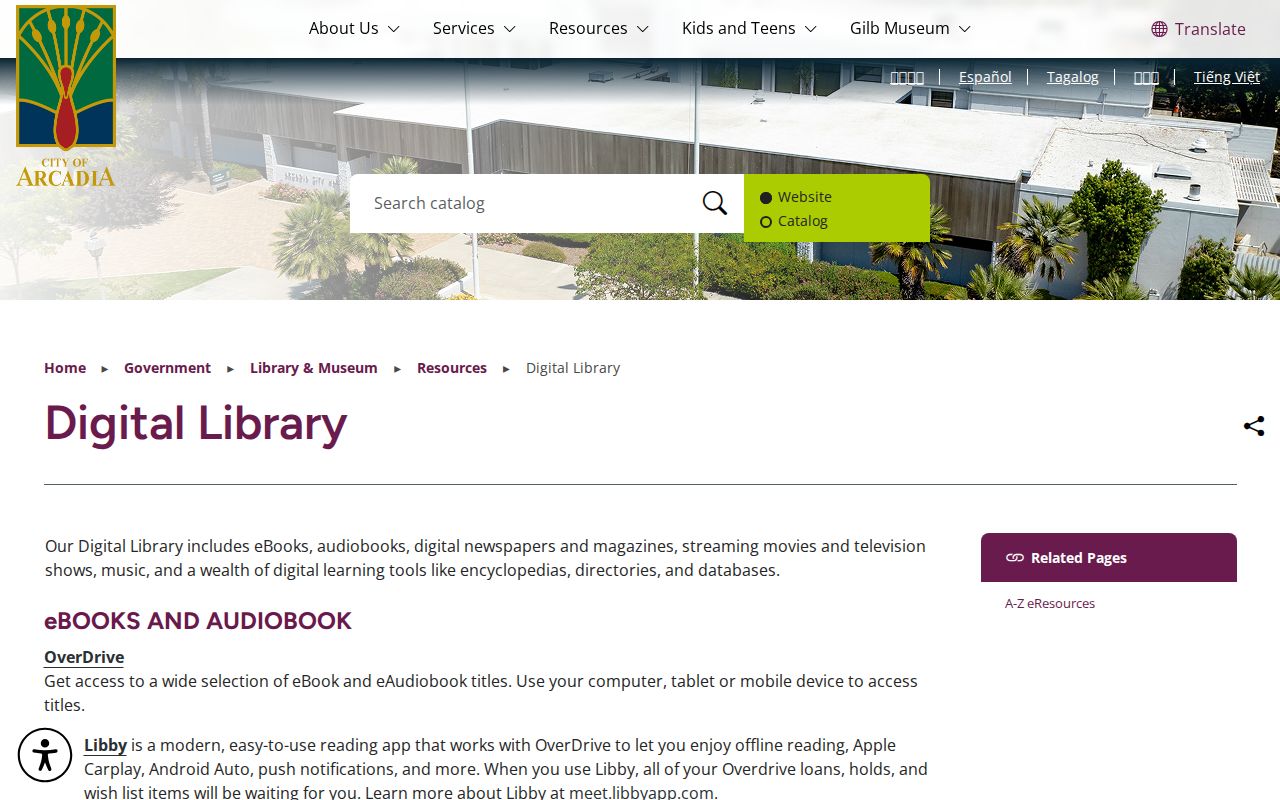
The digital guide widens an Arcadia city directory search without pretending that every Arcadia historical item is a searchable name list.
Arcadia Directory Gaps Need an Honest Note
No official web inventory enumerates each Arcadia directory year, publisher change, missing volume, or reverse section. No official Arcadia source located a dedicated Arcadia Sanborn set. The library, Library of Congress, Los Angeles Public Library, and FamilySearch catalogs are appropriate places to check, but a search that finds no Arcadia map should be reported as “no map found,” not replaced with a different city’s map.
Likewise, an Arcadia directory entry is not a deed. Pair printed occupants with the county’s offline Arcadia recorder index when ownership matters, and pair a name with a case number or vital-record eligibility when an event matters. Printed evidence is valuable precisely because it captures a date and a local context, but its limits should remain visible.
Ask the History Room for an itemized shelf check before planning a long sequence of years. Staff can identify which publisher is present, whether a reverse section survives, and whether a newspaper or obituary citation belongs to the same local collection. A careful citation records the volume title, year, page or section, collection, and the date of access.
That habit also protects the next Arcadia searcher. A missing year becomes a documented gap, not a false claim that no one lived at the address. If the printed trail ends, move to the county deed index, census schedules, planning packets, or probate instead of repeating the same surname search.